Bill King
Vice President of Business Administration
Cirrus Aircraft
Duluth, Minnesota 55811
 

Dear Bill: 

I own one of your aircraft. There are some nice things about the Cirrus. But a few things, from a safety standpoint, really suck. First, the doors don’t stay closed. Second, too many pilots and passengers are getting killed when pilots try to land the thing. Third, the fuel gauges don’t work.

I read your comments on each of these issues in today’s Duluth News Tribune. Considering that they come from a company that prides itself on “celebrating safety,” I found some of the comments disturbing.

The doors.

Bill, they pop open. A lot. It’s always a distraction when it happens. If they pop open at a bad time, it can spell real trouble. More on that here

I read how you flew from one airport to another a few weeks ago with a door that wasn’t shut, and

Continue Reading A Letter to Cirrus Aircraft: Please Fix Your Plane

The pilot of the Otter that crashed in Alaska on Monday, killing Senator Stevens and three other passengers, encountered some very bad weather.  Low ceilings.  Fog and rain.  Gusty winds.

Rugged terrain only complicated things.  Fortunately, the pilot had tons of experience  — tens of thousands of hours.  According to the Alaska Dispatch, had any less talented pilot been at the controls, the death toll surely would have been higher.

The fact there were four survivors is testament to [the pilot’s] skills. [He] maneuvered that plane like no other mere pilot to save lives.

So is the pilot a hero?  No.  Not quite.

There’s an old saying in aviation: "a superior pilot is one who exercises superior judgment so as toN455A by jkero avoid having to exercise his superior skills."  In this case, a pilot exercising superior judgment might have turned around before tangling with the worst of the weather.  Or, better yet, never left the comfort and safety of the lake lodge in the first place.

The Weather was Bad 

When the pilot took off from the lake where the lodge was located, the weather was bad.  It was bad at nearby Dillingham airport.  It was bad at the river camp that was to be their destination.  And it was bad everywhere between.

A pilot who flew the same valley where the crash occurred confirmed to the LA Times that it was bad there too.  "It was just awful weather. . .I came through that valley at about 100 feet off the ground with about a mile of visibility."

Now, bad weather doesn’t mean a good pilot must stay on the ground.  For example, the airport at Dillingham has various instrument approach procedures that will allow planes to land safely in some pretty crappy weather. No undue risk. No sweat.

But this pilot wasn’t headed to Dillingham.  He was headed to a fishing camp on a nearby river.  No instrument approach procedure would guide him through the clouds.  If this pilot was going to get there, he’d have to do it without instruments. He’d have to do it by looking out the window.  Seat of the pants stuff.  All perfectly safe, as long as the weather is good enough for you to see where you are going.

Controlled Flight into Terrain

So what exactly happened?  What we know about the accident is consistent with "controlled flight into terrain."  Opting out of the instrument flight system, the pilot had to stay under the Senator Stevens Plane Crash Wreckageclouds.  He couldn’t go through them because once inside, he wouldn’t be able to see and might bump into something hard and pointy.  So he had to stay in the clear and visually pick his way around the terrain in his path.  But as he maneuvered under the low clouds and around the fog, he suddenly came upon a mountain’s steep up-slope.  He shoved the throttle forward, pulled the nose up and began a climb.  But the terrain rose faster than could his aircraft.  He bellied onto the rising slope while in full control of a perfectly functioning aircraft.

At least that how it looks.

According to John Bouker, the pilot who found the wreck: 

The Otter had plowed into the hill. He bounced up the mountain. He looked like he was in a full-power climb. . the plane appeared mostly intact.

That’s a classic "controlled flight into terrain” scenario.

Poor Decision Making   

This morning a pilot who used to fly search and rescue out of Dillingham called me to talk about the crash.  He pointed out that the state of Alaska accounts for more than a third of all commuter and air taxi crashes in the entire country.  That’s right: one state accounts for a third of all the nation’s crashes.  And more than 80 percent of those crashes are due to poor decision-making.

Alaskans seem to accept aviation tragedies as part of life in the wilderness.  My caller suggested that poor decision making seems to be not just tolerated, but sewn into the very fabric of Alaskan aviation community. 

The question is not the whether the pilot had the skills to “maneuver” the aircraft around difficult terrain. Or whether he had the experience necessary to pick his way around the obstacles along the route. Or whether he brought the aircraft down with the least impact possible.  The question is whether, given the weather, he should have attempted the flight at all.

I can easily imagine that a nice fire was burning in the lodge fireplace when the pilot loaded up his passengers. If ever there was ever a flight that didn’t need to be made, it was this one. 

Yet it was.  

Cirrus N146CK crashed on August 4 at Deer Valley, Airzona.  The pilot was killed.  Just before the accident, the aircraft’s door popped open.  We know that because the pilot reported to air traffic control that his door was open and that he needed to return to the airport to close it.  Plus, surveillance cameras confirmed that the pilot’s door was indeed ajar. 

The plane’s door popped open? What’s with that? 

The Cirrus doors are poorly designed.  It’s that simple. They just don’t stay shut in flight.  

The plane flies okay after a door pops open.  But the distraction can be dangerous, and can lead to a loss of control, as demonstrated by this 2009 Cirrus crash.  Following the 2009 accident, John

Continue Reading Cirrus Crash at Deer Valley, Arizona: Door Opened (Yet Again. . .)

When the evidence needed to reconstruct an aviation accident is lost or destroyed in the crash, can the victim nonetheless hold whoever caused the accident accountable?

Yes, if the legal doctrine of "res ipsa loquitur" apples — Latin for "the thing speaks for itself."

Most courts recognize that air crashes do not normally occur unless someone, somewhere, was negligent.  It’s just a matter of who.  If circumstances point to one particular person above all others, then "the thing speaks for itself," and that person can be held accountabe even without any physical evidence to prove the case.

Let’s say an airplane’s engine fails and the plane crashes. The pilot survives but is badly injured. The key engine components are either battered beyond recognition, destroyed by the post-crash fire, or never located. Under the circumstances, it may be impossible to ever determine exactly why the engine failed.  There may be little chance of determining from the wreckage who was responsible for the accident.

Now assume that engine work had been performed on the plane just before the accident. Under the circumstances, one might suspect that the engine failed because the mechanic who performed the engine work did something wrong.  Of course, there are other possible explanations for the engine failure as well.  But if the injured pilot can prove that the mechanic’s work is the most likely explanation, a judge or jury may decide that the maintenance shop is responsible, even without any physical evidence to rely on.

To invoke the doctrine of res ipsa loquitur against the maintenance shop in this example, the injured pilot must prove that:

  1. The engine would not have failed unless someone was negligent;
  2. The maintenance facility had exclusive control of the engine during the key time period (that is, only the facility’s own mechanics had access to the inside of the engine when it was opened up); and
  3. The pilot did not cause or contribute to the engine failure (by, for example, running out of gas).

Even if there isn’t enough physical evidence to determine how or why the engine failed, if the pilot can prove all these three things, he may nonetheless be able to hold the shop responsible for his injuries.

An FBO is not supposed to rent an aircraft to a pilot who the FBO knows isn’t competent to complete the planned flight safely. If it does, and a passenger is hurt or killed by the pilot’s mistake, the victim or his family can hold the FBO responsible. That’s the law of "negligent Negligent entrustment of aircraftentrustment."

A pilot who doesn’t hold the proper license or rating to operate the aircraft he is seeking to rent is probably not competent to complete the planned flight safely.  But what if the pilot is properly licensed and meets all the FAA’s other requirements? If the FBO rents the aircraft to the pilot, can the FBO still be held responsible for what turns out to be the pilot’s mistakes?

Sometimes, the answer is yes.

The landmark case is White v. Inbound Aviation. A young pilot had just recently received his private pilot’s license. He was comfortable flying the FBO’s Piper Archer in which he had been "checked out" by one of the FBO’s instructors. The FBO felt the renter was a good pilot.  It felt, however, that the pilot should obtain some additional instruction in "mountain flying" before flying to an airport in the mountains nearby.  The FBO felt that without the instruction, the pilot might not be able to handle the special challenges presented by "high density altitude" airports. 

One day the pilot showed up to rent the Archer. He told the FBO that he wanted to fly two friends to Lake Tahoe airport, an airport in the mountains.  The pilot hadn’t obtained the mountain-flying instruction, but the FBO rented the aircraft to him anyway.

The pilot landed at Lake Tahoe airport without incident. But he wasn’t prepared for the effects of the altitude, heat, and weight of the aircraft on takeoff.  When he attempted to depart, he crashed, killing himself as well as his two passengers.

The family of one of the passengers sued the FBO, arguing it should never have rented the plane to the pilot for this particular trip. The jury agreed and held the FBO liable.Archer II by Markus

The FBO appealed.  It argued that the pilot held a license that legally entitled him to fly anywhere he wanted, including mountain airports like Lake Tahoe. That, the FBO argued, should have been the end of the matter. If the pilot was competent in the eyes of the FAA, he should have been deemed competent in the eyes of the court.

The court of appeal disagreed, and affirmed the jury’s verdict against the FBO.  Though the young pilot may have been a competent pilot generally, that wasn’t the issue.  The FBO knew that, notwithstanding his license, the pilot wasn’t competent for the particular flight he had planned.  As the court of appeal noted:

[The issue as plaintiffs framed it] was not whether [the pilot] was competent in general to pilot an aircraft but whether [he] was competent to ‘operate the aircraft that he operated on the day he operated it and in the manner in which he operated it under the conditions he experienced … on July 3rd with three people on board going to Lake Tahoe.’

The FBO knew that, even though he was properly licensed, the pilot was not competent to conduct the particular flight he had planned under the conditions that existed on the day of the accident.  The court of appeal ruled that, therefore, the jury properly held the FBO liable for the accident under the law of negligent entrustment.  

The American Association for Justice’s Annual Convention begins today at the Vancouver Convention Centre.  The program for aviation lawyers will be held on Monday, July 12.  The schedule: Vancouver

8:30 – 11:45, Room 215-216:

Speakers will be

Mike Danko – Aviation Litigation Forecast

Ricardo Martinez-Cid – International Commercial Airplane Crashes

Ladd Sanger – Aviation Deposition and Trial Skills

Heidi Snow – Clients and Grief – Insights

Vicki Norton – Three Things a Commercial Airline Pilot Would Change

1:30 – 2:30, Room 101 – 102:Teashouse

Aviation Law Section Meeting

5:30 – 7:30:

Aviation Law Section Reception (sponsored by The Danko Law Firm and Slack & Davis.) 

The Teahouse 

7501 Stanley Park Drive

All are welcome. 

When Cory Lidle’s widow sued Cirrus Design, it caused a bit of an uproar in the aviation community.  Her suit alleges that it was a defect in the aircraft’s flight controls that caused the Cirrus SR-20 to slam into a Manhattan hi-rise.  That claim led many to call the suit frivolous.  After all, the NTSB determined the accident was caused by pilot error, plain and simple. Right?

Cirrus asked the federal judge who is hearing the case to toss it out as being based on "junk science." Cirrus argued that under legal precedent known as Daubert v. Merrell Dow Pharmaceuticals, the judge must act as a "gatekeeper."  That means she must review the expert

Continue Reading Lidle v. Cirrus: Claim Not “Junk Science”

Many airports in the western United States are located at altitude.  In the thin air, a departing aircraft’s propeller and wings are less aerodynamically efficient.  And without a turbocharger, the aircraft’s engine won’t be able to produce full power.  All of that hurts the aircraft’s ability to climb. Unless the aircraft is handled properly, after lifting off the runway it may travel for a distance

Continue Reading Summer Means High Density Altitude Airplane Accidents

A passenger injured in an aircraft accident can’t sue the aircraft manufacturer if the part that caused the crash is older than 18 years. Any such suit would be barred by the General Aviation Revitalization Act, or GARA.

What if the accident was caused by a mistake in one of the aircraft’s manuals rather than a defect in the aircraft itself?  If the manual is older than 18 years, does GARA protect the manufacturer from liability for its error? 

It depends.  The manufacturer is off the hook if the manual is properly considered a "part" of the aircraft.  Some manuals are. Some aren’t.

A flight manual (sometimes called a "pilot’s operating handbook" or "flight handbook") is properly considered "part" of the aircraft, and so GARA protects the manufacturer. For example, in Caldwell v. Enstrom Helicopters, the pilot’s family blamed a helicopter crash on the flight manual’s failure to say that the last two gallons of fuel in the helicopter were unusable.  As a result, the pilot believed he had sufficient fuel but in fact did not.  He crashed just minutes from his destination.

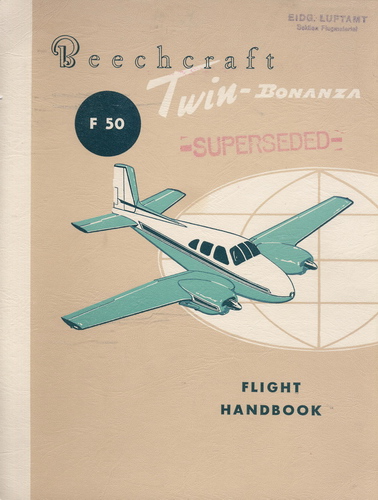
The Caldwell court said that Twin Bonanza Flight Manualmanufacturers are required by regulation to provide a flight manual when it delivers the aircraft to the customer.  The manual must be carried in the aircraft at all times thereafter. Therefore, the manual was properly considered to be an aircraft "part."  Because the manual at issue was more than 18 years old, GARA applied to protect the manufacturer from liability for any errors. 

But the situation is different when the manual is a maintenance manual. A manufacturer can sell an aircraft without providing to the buyer a maintenance manual.  Thus maintenance manuals, unlike flight manuals, are not a "part " of the aircraft, and GARA doesn’t apply. At least according to Rogers v. Bell Helicopters Textron, a case decided earlier this month by a California appellate court. 

In Rogers, the pilot claimed the accident resulted from faulty instructions in a maintenance manual for balancing the helicopter’s tail rotor. The court ruled that, despite the fact that the manual was more than 18 years, GARA didn’t apply and so the pilot was entitled to sue.  

Unlike a flight manual that is unique to the aircraft, used by the pilot, and necessary to operate the aircraft, a maintenance manual applies to different aircraft models, is used by the mechanic, and only for troubleshooting and repairing the aircraft.

According to Rogers,, GARA won’t protect a manufacturer from liability for mistakes in its maintenance manuals, regardless of how old the manuals are. 

The plaintiff in Rogers was represented by Louis Franecke of San Rafael. 

I wrote here that mediations are often preferable to settlement conferences. The mediator is chosen by the parties, while the trial judge who presides over the settlement conference generally is not. Further, the mediator often has more time than the trial judge to devote to the settlement process.

This month’s Forum Magazine published an article by Kristine Meredith and Judge John Judge John F. Herlihy (ret.)Herlihy (recently retired from the bench and now a private judge) that touched on this very topic.  Kristine asked Judge Herlihy, who has 29 years experience on the bench, why the parties should even bother attending a pre-trial settlement conference if the case couldn’t be settled at a mediation.  According to Judge Herlihy, timing can be everything:

As the case gets closer to trial the [likely] outcome becomes clearer.  I often told lawyers that although the case didn’t resolve at mediation, as a trial judge, I had an advantage that the prior mediator did not have.  If the case didn’t resolve when it was in my department for trial, then the next step was to call for the jury panel.  That immediacy had a direct effect on the parties’ and attorneys’ willingness to try one last time to settle.

"Reality Check: A Trial Judge’s Approach to Settling Cases," appears in the May/June issue of Forum Magazine.  The full text is available from the Consumer Attorneys of California