Pilatus Crash at Butte Montana and Occam's Razor

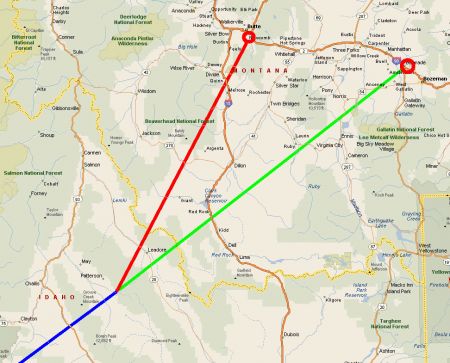
The pilot's original destination was Bozeman, Montana.  But the pilot amended his flight plan and diverted to Butte.  The pilot did not tell air traffic control why he was diverting.  About 25 minutes later, as the aircraft approached for landing at Butte, it went out of control and crashed. 

The NTSB is now investigating two things: (1) why the pilot diverted to Butte, especially when he was so close to Bozeman, and (2) why the pilot lost control and crashed so near the runway at Butte.

Some possible explanations for diverting include:

  • Low fuel;
  • Concerns about weather at the destination;
  • Sick passenger;
  • Need for a bathroom; Diversion to Butte
  • Mechanical issues;
  • Medical issue afflicting the pilot.

Some possible explanations for losing control of an aircraft on approach to landing include:

  • Mechanical/structural issues;
  • Icing;
  • Improper weight and balance (aircraft load not properly distributed);
  • Pilot error; 
  • Medical issue afflicting the pilot.

 “Occam’s Razor” suggests that a theory relying on one anomaly to explain an accident sequence is more likely to be correct than one relying on two anomalies. In other words, the simplest answer is usually the best answer.  Here, one anomaly that explains both the mysterious diversion to Butte and the loss of control 25 minutes later is a medical issue afflicting the pilot.

A Butte coroner, Lee LaBreche, autopsied the pilot. He found that the 65 year-old did, in fact, have heart disease.  He thus noted that "the presence of a pathologic condition of the heart causing this accident cannot be excluded."  Nonetheless, LaBreche felt a heart attack was unlikely because the pilot never reported any symptoms to air traffic control. According to Examiner.com:

Federal investigators have said that in [the pilot's] last recorded communications with air traffic controllers he gave no indication of any problems. LaBreche said that supports the premise that there was no medical emergency.Pilatus PC-12

The coroner's reasoning is flawed. Pilots have little hesitancy about reporting mechanical problems.  However, a pilot would be very reluctant to report to air traffic control that he is having the symptoms of a heart attack.  That sort of report will keep a pilot grounded for a long, long time, even if the symptoms ended up being a false alarm. So, while the fact that the pilot reported no problems may support the premise that he had no mechanical issue, it says nothing about whether he had a medical issue.  For those who favor Occam’s Razor as an investigatory tool, a heart attack is the most likely cause of this accident.

Related Post: NTSB Reports Show Pilatus Pilot Under Stress

Trackbacks (0) Links to blogs that reference this article Trackback URL
http://www.aviationlawmonitor.com/admin/trackback/136242
Comments (5) Read through and enter the discussion with the form at the end
John Moravec - October 15, 2009 6:04 PM

The reasons for this crash have puzzled me for some time. I find this explantion to be well reasoned. And yes, I am a fan of Occams Razor. Even so, I still wondered about the diversion. The airports are very similar, and from the direction of travel, only a few minutes is saved by going to Butte. So why the diversion? Could it have been because St. James hospital in Butte is the only trauma center in southwestern Montana? I think a medical emergency the most likely. And the Pilatus does have a bathroom!

Mike Danko - October 15, 2009 7:43 PM

John-

Thanks for dropping by.

Interesting thought. But the pilot would have to have been darned familiar with the area to know that St. James hospital was his best choice. Perhaps he was. I'd be interested to get that background.

Mike

R. Terbet - March 25, 2010 2:32 PM

Could hypoxia have been a factor?

Mike Danko - March 25, 2010 3:37 PM

Interesting thought. Possible, but unlikely.

In the typical hypoxia accident, the pilot becomes impaired at altitude. He fails to descend before he loses consciousness altogether. The pilot never regains consciousness, suffers brain damage from the lack of oxygen, and dies. The plane crashes, often after it runs out of gas some time later.

In this case, the air traffic controller did not report that the pilot seemed impaired in any fashion when he requested the deviation and the descent. That suggests he wasn't suffering from hypoxia.

The pilot then descended -- apparently under control -- all the way to near pattern altitude, where he arrived over or near the airport. Again, that suggest no hypoxia issues.

Finally, assuming for argument's sake that the began the descent because of a problem with his pressurization, or that he recognized he was suffering early-stage hypoxia, he should have regained his capacities upon reaching a "breathable" altitude -- say 12,000 feet.

Mike Danko

Common sense in CA - December 30, 2010 9:54 PM

A few comments only:

1) The Pilatus was piloted by only ONE pilot. With 13 others on board, none of them being pilots, and the bathroom being located in the rear of the plane, under one of the seats which was occupied by another passenger, the bathroom break was most likely not an option......

2) Regardless of whether or not the fuel was freezing and not feeding from one wing tank, or the fuel pump heater was inoperative and giving fuel pressure/flow warnings to the pilot requiring the request for a lower altitude, or there was another problem initiating a diversion to his alternate airport.......this aircraft was being operated by only one pilot! Does'nt one have to ask himself if this was a wise decision? A veteran 65 year old pilot, trusting himself enough to handle the challenges of weather, full passengers(small kids), in-flight emergencies, diversions to a possibly unfamiliar alternate airport covered in snow, and oh, I forgot, Still remembering to fly the damn airplane! Simple: Overburdened, Stalled, Crashed!

Post A Comment / Question Use this form to add a comment to this entry.


Remember personal info?
Send To A Friend Use this form to send this entry to a friend via email.